


SUMMER DRENCHING DON’T LET THE WORMS BURN YOU!
Written by Dr Tim Elliott Dr Tim Elliott is a large animal scientist with over 15 years’ experience. Tim has a particular…
Nationwide shipping! Now with Express shipping option as well. Click here for details.

ning and turnoff. According to the Meat & Livestock Australia report on cost of endemic disease, neonatal mortality costs the Australian sheep industry A$540m annually. It was estimated that Merino producers on average lose 17% of singles and 30% of twin lambs between scanning and weaning. Attention to lamb survival will have important economic benefits to sheep producers, especially since lamb survival and health can be strongly influenced by management and animal health inputs.

Studies have shown that 80% of lamb deaths in Australia occur in the first 48 hours after birth1,2.
In a trial that determined cause of death in 3198 lambs across Australia, starvation/mismotherment was found to be the highest single cause, accounting for 25% of deaths. Stillbirths were next at 21%, followed by birth injury (19%) and dystocia (9%). Predation accounted for 7% of lamb deaths and cold exposure 5%, while infection and misadventure accounted for only 1% each. Four percent of deaths went undiagnosed.
Single lambs were more likely to die from stillbirth or dystocia, while twin lambs had a higher chance of dying from starvation or birth injury.
Cause of death can be determined by collecting lambs and submitting them for post mortem examination. Your veterinarian can assist with how to diagnose causes of death. Dead lambs should be collected each day and stored in a cool room immediately after collection, or examined within 12 hours of death. There are many tell-tale signs that provide evidence to determine the reason why the lamb did not survive. Bodyweight, girth and crown-rump length are recorded, along with external signs, including the presence of membranes on the feet that would indicate if the lamb had walked or was dead at birth.
Internal organs are examined and the presence of milk in the stomach, air in the lungs and haemorrhage in various organs can help piece together whether the lamb had starvation, birth trauma or was unable to breathe.
More information on lamb mortality diagnosis can be found at the website https://www.agric.wa.gov.au/livestock-biosecurity/ewe-abortion-and-newborn-lamb-deaths-surveillance-programOpens in a new window
Ewe nutrition will determine several important behavioural and physiological factors:
 Hungry ewes will walk away from lambs leading to high rates of mismotherment, particularly in twin birthsEwes with low body condition score or under-nutrition will fail to provide adequate volume and quality of colostrum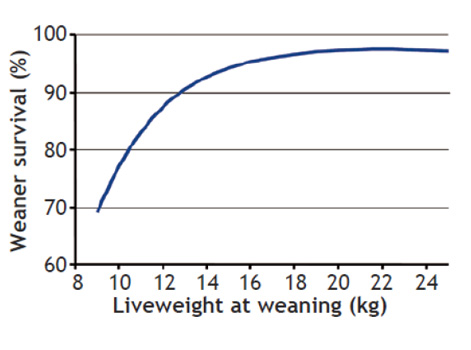

(source: Lifetime ewe manual)
Low bodyweight lambs struggle to maintain body temperature. All lambs have a high surface area to bodyweight ratio, but particularly those under 3-4kg rapidly lose energy if left exposed. Lambs that suckle strongly can survive well in cold conditions, but in general lambs are not tolerant of wind. Pasture height greater than 10cm improves lamb survival as it allows lambs to take shelter from wind, particularly in cold, wet conditions. Shelter belts and windbreaks can be maintained in lambing paddocks to improve ewe and lamb comfort.
Twin-bearing ewes have higher rates of lamb survival if lambing in smaller mobs (100 to maximum 200). This is especially important for maidens, as they are inexperienced and more likely to ignore the lamb’s attempts to suckle. Pasture availability should be highest for twin-bearing ewes (>2000 kg DM/ha preferable) to avoid ewes needing to walk away from lambs looking for feed.
Mothering ability is repeatable across years, so a ewe that fails to rear a lamb one year is a good candidate for culling. Also, good maternal characteristics are enhanced within a flock by:
Great range - quick and secure delivery
Buy securely online and pickup at your local store
Call your local store and come on down to pickup