MARKET SUMMARY – WEEK 19th JANUARY 2026
WEATHER Since the start of the year northern Australia has received a soaking of 200-600mm. Rain has been concentrated in the Kimberley…
Nationwide shipping! Now with Express shipping option as well. Click here for details.

1-7 Blake Street, Nathalia, VIC, 3638 Australia
WEATHER
Since the start of the year northern Australia has received a soaking of 200-600mm. Rain has been concentrated in the Kimberley region of WA and the top end, Katherine and Barkly regions of NT, and the northern half of QLD and well into central regions. Lesser falls of 25-100mm were received in southern Qld and parts of northern and central NSW with falls south of these regions mainly confined to eastern areas of NSW & VIC. Most of Tassie has had between 10-50mm with western half receiving the heaviest falls.
AUSTRALIAN DOLLAR
Has traded in a narrow range between 66.7-77.3USc with fluctuations mainly dictated by Trump antics; geopolitical (arresting Maduro, threatening NATO) and domestic policy moves (threatening the independence of the US Fed Reserve by lauching a criminal investigation into Chairman Powell).
LIVESTOCK
Cattle markets have commenced the year moderately firmer (5-10c/kg lw or 2-5%) than pre-Christmas rates led by feeder and restockers and cattle accredited for the EU-accredited which have moved to a 20-50c/kg lw premium over other cattle types. Cattle markets across the south-east will get a sterner test this week as dry weather lifts sales volumes. QLD markets will be weather affected as flooding recedes, but truck movements restricted in some areas.
Restrictions on beef imports into China that took effect on 1 January promise to have a significant impact of global beef and cattle markets over the next few years. The restrictions were introduced after a Chinese anti-dumping probe found beef imports have done damage to China’s domestic beef industry. Effectively China will restrict beef imports by placing country specific quotas on how much a country can export to China with exports above these levels levied with a tariff of 55%. The restrictions are in place for a 3-year period and will have the effect of significantly restricting beef imports from major suppliers Brazil and Australia. Around one-third of Australia’s export volumes to China will be directly affected with our quota 205,000t against 2025 export volumes of 273,000t. Industry discussions about a quota management system are ongoing.
In contrast to the cattle job, lamb markets opened the year moderately (-5%) lower, while the sheep market was firmer with weight hard to find. The opposite was true in lamb markets where a flush of very heavy weight lambs off grain have seen processors issue penalties for lambs that are too heavy. Lambs are in the $10-11/kg dw range while sheep have settled in the $7-8/kg range. Hot and dry weather boosted yardings across southern markets last week, contributing to the softer price trend.
GRAIN
Not a lot to report in local wheat markets with prices a few dollars per tonne either side of pre-Christmas rates with slow local farmer sales helping prices to remain firm. International grain markets were dealt a blow by the USDA revising 25/26 production and end stocks upwards again (see below) last week when most had been anticipating a downward revision. But prices across the grain complex were resilient with global corn prices the main casualty, losing around 5% while wheat and soybeans were unmoved. Lower corn prices reinvigorated export demand for US corn last week which had been flagging (losing sales to cheap Argie wheat).
International feed barley prices have improved to be now +US$20/t above wheat (normally trades at a discount) which illustrates the impact that cheap Argie wheat is having. WA feed barley gained $15/t last week to $331/t FIS port and I suspect there is more upside. Expect feed barley to be tightly held by growers on the east coast as a drought hedge and remember to factor in increased local demand from lamb and cattle feedlotters.
Sorghum has firmed on sustained export demand from China while lentils and chickpeas saw some better export demand as stocks start to dwindle ahead of the sub-continent harvest and as the peak Ramadan consumption period approaches.
Canada reached a deal with China to lower tariffs on canola from 84% to 15% by 1 March 2026. The market reaction has been muted with the trade waiting to see the impact on Canadian canola exports.
The International Grains Council forecast total grains production in 25/26 at a record 2.461 billion metric tonnes, up 31million tonnes from its previous projection. As well as bumper maize (corn) and wheat outturns, barley and sorghum crops are also expected at multi-season peaks. Global wheat production was upwardly revised to 842 million tonnes, up from 830 million seen previously, driven partly by improved outlooks for Argentina and Canada. Global corn production in 2025/26 was increased by 15 million tonnes to 1.313 billion tonnes driven mainly by an upgrade for the US (432.3 million tonnes from 419 million). Global carryover stocks of grains in the 2025/26 marketing year are expected to rise to their highest level in nine years. If realized, carryover stocks would increase by 8% year on year, marking the fastest expansion since the 2017/18 marketing year.
WOOL
The Australian wool market has resumed after the annual three-week Christmas recess in stunning fashion, recording sharp rises across the merino fleece sector of the market and solid gains in the others. Many industry observers were predicting a dearer market, based on overseas sales made during the break, however the strength in the market surprised many. The Eastern Market Indicator (EMI) rose 107c/kg or 6.9% for the week to 1614c/kg. The EMI is now 460c higher than the corresponding sale of the previous season, an increase of 38.7%. The EMI is now at its highest point since January 2020, when it reached 1,643c/kg.
SUGAR
Has held at 14.96USc/lb but is under pressure as a weak real encourages Brazilian exports sales while reports out of India are suggesting a big lift in sugar production.
COTTON
International cotton values were headed for a weekly gain of 25pts to 64.66USc/lb owing to a supportive USDA supply-demand report last week that projected lesser production and steady exports. Australian production will be lower this year with less planted due to lower water allocations, dry conditions in some dryland areas and low prices with some estimates that plantings could fall by 15%.
CHART OF THE WEEK
China is currently the largest destination for Brazilian beef exports. In 2025, Chinese imports of Brazilian beef totalled 1.7 million metric tonnes, representing 48.3% of Brazil’s export volume. Growth in the Chinese imported beef market and increased Chinese imports of Brazilian beef have largely shielded Australian exporters from the impact of the sharp rise in Brazilian beef production over the past 5 years. However, the recently announced Chinese restrictions are likely to accelerate efforts by Brazil to diversify its beef exports, lead to a significant increase in competition in Australia’s key export markets.
The effective implications of the Chinese restrictions can be summarised by discussions in Brazil around a Chinese quota management system. The Brazilian beef industry is talking about capping monthly exports to China at 80,000t per month against last year’s export volumes to China of 140,000t per month, meaning Brazil will need to find new markets for around 60,000t of beef exports per month. A good chunk of this is likely to find its way onto the US lean manufacturing beef market, stiffening export competition vs Australian exporters, who virtually had this market to themselves in H2 2025. For anyone interested, I am writing a report analysing the impacts of the Chinese restrictions on the Australian beef and cattle industry. You can inbox me for a copy.
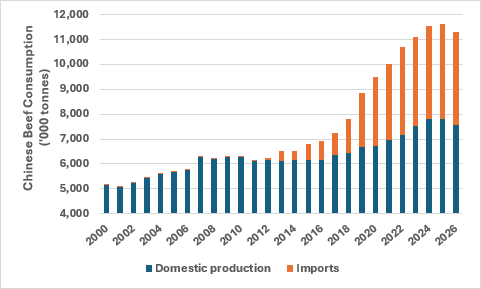
Source: USDA | This chart shows the sources of beef consumed in China
Great range - quick and secure delivery
Buy securely online and pickup at your local store
Call your local store and come on down to pickup