


CATTLE MARKET UPDATE – APRIL 2025
Source: MLA Heavy NSW turnoff buckles pricesDespite global beef demand proving resilient to mounting cost of living pressures, Australian cattle prices have…
Nationwide shipping! Now with Express shipping option as well. Click here for details.


Written by Richard Koch
Welcome to the weekly market summary for week commencing 12th October
Take away points:
WEATHER
Some decent rain of 15-100mm for parts of the WA eastern wheatbelt, pastoral areas of south-west WA and through Tasmania. There was patchy light rainfall through a narrow strip of the Riverina and south-east QLD while the lower south-east of SA and the western district were clipped by a cold front delivering up to 25mm rainfall in parts. Parts of the NT Top End and central and south-east QLD received 10-100mm in storms over the weekend.
The forecast is calling for widespread falls of 10-15mm through most cropping areas of SA/VIC with heavier falls for Tasmania. Moisture moving in from the north could bring a further 15-25mm to the NT Top End and to parts of south-east QLD.
AUSTRALIAN DOLLAR
$A fell out of bed in Friday night to 64.7USc after Trump threatened more tariffs against China and cancelled a planned meeting with President Xi after China dramatically expanded its rare earths export controls on Thursday. The potential for more tariffs on China and serious issues emerging in the French (political instability and budgetary issues) and German economies (shrinking exports) are raising doubts about the strength of the global economy, encouraging a sell-off in growth dependent currencies.
LIVESTOCK
Cattle markets continue to ease gently (2-6%) off September highs as QLD turnoff ramps up seasonally. Reflecting mixed Spring seasonal conditions, slaughter cattle prices are holding well but restocker categories are under pressure.
US lean beef prices continue to edge up while the US boxed beef cut-out (wholesale grainfed beef prices) has fallen weakening US processing margins (US packer losses are $200/head). Lower US grainfed beef prices aren’t being passed through to fed cattle prices due to excess capacity in the US processing sector. This situation can’t continue in the longer-term without some adjustment. There is very little official data currently available with the United States Department of Agriculture (USDA) being affected by the US Government shutdown.
The situation was similar across the sheepmeat complex with hotter weather and tightening pasture conditions flushing out increased numbers and pressuring prices 2-4% lower. Higher mutton values teased out some increased supply while store amd trade lamb categories were well supplied and copped the largest declines with other slaughter categories steady. Prices remain at historical highs at $10-11/kg dw across lamb categories and $7.50-8/kg dw for mutton. Restocker lamb categories should soon find some support from graziers looking for stock to place on failed crops or stubbles.
GRAIN
International grain values remain stuck at 5-yr lows on abundant old crop supply and a lack of threats to new season crops. Harvesting of a record US corn and soybean crop (that needs to find another major buyer in the absence of Chinese demand) continues to exert downward pressure on prices.
Grain values across the southern region have risen by up to $10/t in the past week in response to critically dry conditions which are biting into yield potential and seeing a bigger-than-expected area of cereals cut for hay. Concerns are mounting that potentially high yielding crops across the south will be lacking moisture to fill which may result in pinched grain with high screenings and low-test weights.
WA wheat is now the world’s cheapest into Asia with the recent rise in Black Sea values while China has reportedly booked 25 barley vessels from WA ports. The only problem is that the grower doesn’t like the price. No sign yet of any buying urgency, with the trade expecting the grower to offer plenty of grain at harvest.
Freshly harvested barley is flowing across the north and being bid at $275/t delivered Downs feedlots, down $25/t for the week, with quality reasonable but lower than hoped for test weights of 68-69kg/hectolitre because of the tight finish. Grower selling has been limited at these lower values.
WOOL
The wool market took a fair step back this week after 10 successive weeks of gains. Merino fleece wool prices fell away by 40-70Ac/clean kg in both Eastern selling centres and by 25-40Ac/clean kg in the WA. One of the largest Chinese top makers had almost no interest at the Sydney auction on Thursday. Higher prices have encouraged increased supply with volumes offered for sale rising to 40,000 bales/week the past fortnight, up from around 30,000 in September. This week sees another 41,000 bales offered at Fremantle and Melbourne sales.
SUGAR
Sugar prices settled lower on Friday, with NY sugar posting a 2.5-week low. Weakness in crude oil and the Brazilian Real are weighing on sugar prices. Oil sank more than -4% to a 5-month low on Friday, and the real tumbled to a 2-month low against the $US. Weakness in crude prices undercuts ethanol prices and may prompt the world’s sugar mills to divert more cane crushing toward sugar production rather than ethanol, thus boosting sugar supplies while the weaker Real encourages export sales from Brazil’s sugar producers.
Sugar prices were already on the defensive, with rising production in Brazil, India and Thailand expected to trim this year’s sugar deficit to just 230,000t according to the International Sugar Organisation (ISO).
CHART OF THE WEEK
The chart below illustrates the stark changes in prices for Australia’s major broadcare agricultural commodities 2023-2025. From their lows in mid to late 2023, feeder steers values have risen from 205c/kg lw to 468c/kg lw (+128%) while lamb values have lifted from 433c/kg dw to 1147c/kg dw (+165%). At the same time, wheat values habve fallen from $410/tonne to 5-yr lows of $300/tonne (-27%). Expect unprecedented levels of grain feeding this year as growers look to add value to their grain and accelerate meat production given attractive prices, as a business are we prepared to support this shift in production focus of our clients?
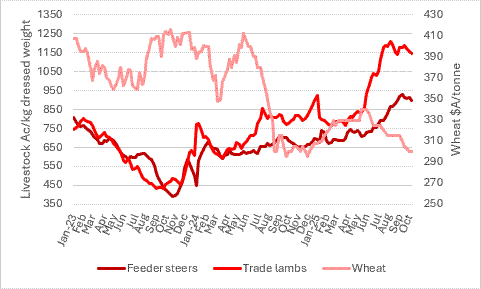
Source: MLA & LSEG | This chart shows the prices of trade lambs vs feeder steers vs wheat
Great range - quick and secure delivery
Buy securely online and pickup at your local store
Call your local store and come on down to pickup
